> For the complete documentation index, see [llms.txt](https://learnpython.strivemath.com/p5-python-web/llms.txt). Markdown versions of documentation pages are available by appending `.md` to page URLs; this page is available as [Markdown](https://learnpython.strivemath.com/p5-python-web/reference/3d-controls/rotatez.md).
# rotateZ()
Rotates in 3D around the z-axis
### Example
### Syntax
```
rotateZ(angle)
```
Input
Description
angle
angle of rotation
### Full Example
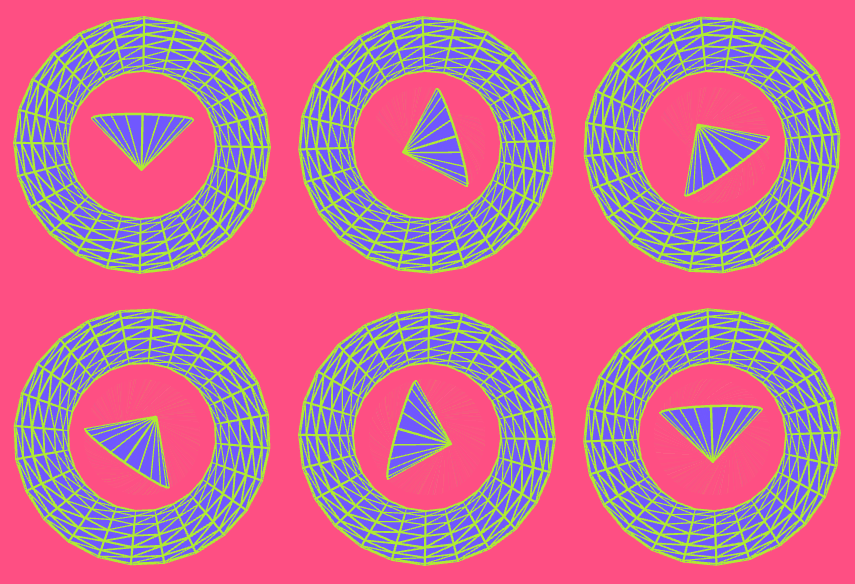
Example Full Code
```python
def setup():
createCanvas(300,300, WEBGL)
def draw():
background(255, 79, 132)
fill(112, 88, 255)
stroke(176, 235, 51)
strokeWeight(2)
orbitControl()
# draw3DAxes(100, (100, 50, 20))
rotateZ(frameCount)
torus(100, 25)
rotateZ(-2*frameCount)
cone(50, 50)
```
### Description
Rotates a shape around z-axis by the amount specified in angle parameter. The angles can be entered in either `RADIANS` or `DEGREES`, depending on the specified angleMode().
**Positive** angles rotates the space from **+x to +y** regardless of handedness. This is the actually the application of the function [rotate()](/p5-python-web/reference/built-in-functions/rotate.md) in 3D.
Why is this the direction of rotation?
The reason is hidden in the mathematical convention of setting up axes such that:
* if one **extends his fingers** of your **Right Hand** in the +x direction
* then **curls his fingers** into +y direction
* his **thumb points** into the +z direction
This is called the **Right Hand Convention** (as if you did it with your left hand, it would fail! it would give the opposite direction). We can write this convention as **+x => +y => +z**.
Extending the sequence with the same order **+x => +y => +z => +x => +y** gives us the convention for rotations about the x-axis and the y-axis as well:
* about x-axis: **+y => +z => +x**
* about y-axis: **+z => +x => +y**
{% hint style="info" %}
Find these documents helpful? Let the people who made them help your child learn to code at [**Strivemath**](https://www.strivemath.com/)**!**
We'd love to hear your Feedback/Comments [here](https://docs.google.com/forms/d/e/1FAIpQLSeqorBAGTya-YBRI-VFjJxtgQtCz3ucGDI96K96sNyuaGuvdw/viewform?usp=sf_link).
{% endhint %}